
While animal-to-human translation requires caution, the mechanistic plausibility — fibroblast stimulation, collagen cross-linking, angiogenesis — is well established. A rat model of full-thickness wounds demonstrated 47% faster closure with GHK-Cu-impregnated scaffolds compared to controls (Gordeeva et al., 2012, referenced in Pickart review). This multi-pathway signaling is why researchers describe GHK-Cu as a “resetting” molecule, it appears to shift aged or damaged tissue gene expression profiles toward a more youthful, regenerative state. The mechanism that distinguishes GHK-Cu from simpler antioxidants or collagen supplements is its direct influence on gene expression. GHK-Cu , glycyl-L-histidyl-L-lysine copper complex, is a signaling tripeptide that the body uses to orchestrate tissue repair, collagen remodeling, antioxidant gene activation, and anti-inflammatory responses.
It occurs naturally in the body (including in blood plasma), but the levels we make tend to decline as we age. It’s a tiny, naturally occurring compound that signals skin to make more collagen, KLOW 80 peptide blend description helps with repair, and may soften fine lines, giving skin a healthier, more radiant look. None of them have large independent RCTs establishing their effects in humans, so comparisons between them are difficult to make with confidence.
Copper is beneficial in small amounts, but excessive copper signaling may increase inflammation or interfere with other active ingredients. Copper peptides are generally well tolerated, but as with any ingredient they are not totally risk-free. These effects are well documented in scientific literature, especially in wound care and tissue repair contexts. GHK-Cu is sometimes described as growth factor-like — because it influences genes involved in regeneration and inflammation. Its primary role is to deliver copper — a trace mineral essential for enzymatic processes involved in tissue repair and antioxidant defense. This has led researchers and formulators to explore topical copper peptides as a way to support aging skin.
Anyone who guarantees immediate results is either deceiving you or marketing tainted substances, and they might be doing both simultaneously. In various cell and animal models, GHK‑Cu demonstrates strong anti-inflammatory effects by reducing key cytokines such as TNF‑α and IL‑6 while inhibiting NF‑κB/p38 MAPK signaling. If your main aim is healthier (younger skin), I have explored the skin-specific processes associated with GHK-Cu in much greater depth. If you are combining for a particular protocol, GHK-Cu works exceptionally well alongside other healing peptides for recovery from injuries and tissue regeneration. In models of ischemic wounds, the injection of GHK-Cu improved fibroblast functionality and significantly sped up skin healing compared to the control group.

Acute tissue repair (including injuries like torn tendons), muscle damage, and gut issues, is where BPC-157 and TB-500 shine. Peptides are uniquely represented by GHK-Cu because it merges tissue repair capabilities with extensive gene modulation. Treves-Manusevitz et al. demonstrated that GHK-Cu enhanced the differentiation of mesenchymal stem cells into osteoblasts, resulting in a 2.8-fold increase in alkaline phosphatase activity, a bone formation marker, compared to controls.
Are there clinical trials showing before and after results for GHK-Cu?
Whether adding more from outside reverses anything is a separate question — and for most uses the human evidence is thin. The amount circulating in blood falls by roughly 60% between your twenties and age sixty. One small study compared it favorably to minoxidil — though the trial wasn’t large enough to draw definitive conclusions. GHK-Cu plasma levels decline from around 200 ng/mL in your 20s to roughly 80 ng/mL by age 60. Topical GHK-Cu works locally in the skin and dermis, it’s supported by the strongest human evidence for skin aging and wound healing.
GHK-Cu operates through multiple mechanisms simultaneously. That decline is why researchers began asking whether restoring GHK could support skin and tissue repair. A clinician who does not understand sourcing risk cannot responsibly evaluate GHK-Cu beyond its established cosmetic role — which is exactly why structured education emphasizes sourcing and regulatory literacy alongside the biology. The considerations become more significant the further one moves from established topical use toward systemic or injectable use — where high-quality human safety data is limited and broad safety claims are not well supported.
These mechanisms are why GHK-Cu is often compared with retinoids; see copper peptides vs retinol for that comparison. In the rats that received GHK-Cu (the researchers found an increase in total protein and collagen synthesis greater than that of the placebo group), demonstrating that “GHK-Cu is able to increase extracellular matrix accumulation in wounds in vivo.”28 In an earlier experiment, from 2015, rats injected with 0.5mcg/kg of GHK were able to spend more time exploring a maze and less time in an immobile “freeze reaction,” suggesting that the peptide reduced their fear and anxiety.27 But after receiving a 0.5mcg/kg injection of GHK, they attacked each other less frequently.26 The researchers noted that a safe human-equivalent dose would be around 35mcg.
Does GHK-Cu Truly Fulfill Its Promised Results?
An FDA-approved adult dosage for Sermorelin has never been established. A randomized dose-ranging trial did still evaluate those lower doses. No regulatory body has sanctioned a GLP-1 microdose regimen. Following adverse events linked to dietary supplement-grade ingredients, injectable glutathione is currently under investigation by both the FDA and CDC. Consult with a healthcare provider regarding the suitability of GHK-Cu for your goals related to skin renewal or tissue repair and discuss safe usage. Compared to pharmaceutical-grade formulations used in clinical environments, the concentration, formulation, and delivery systems of consumer products differ significantly.
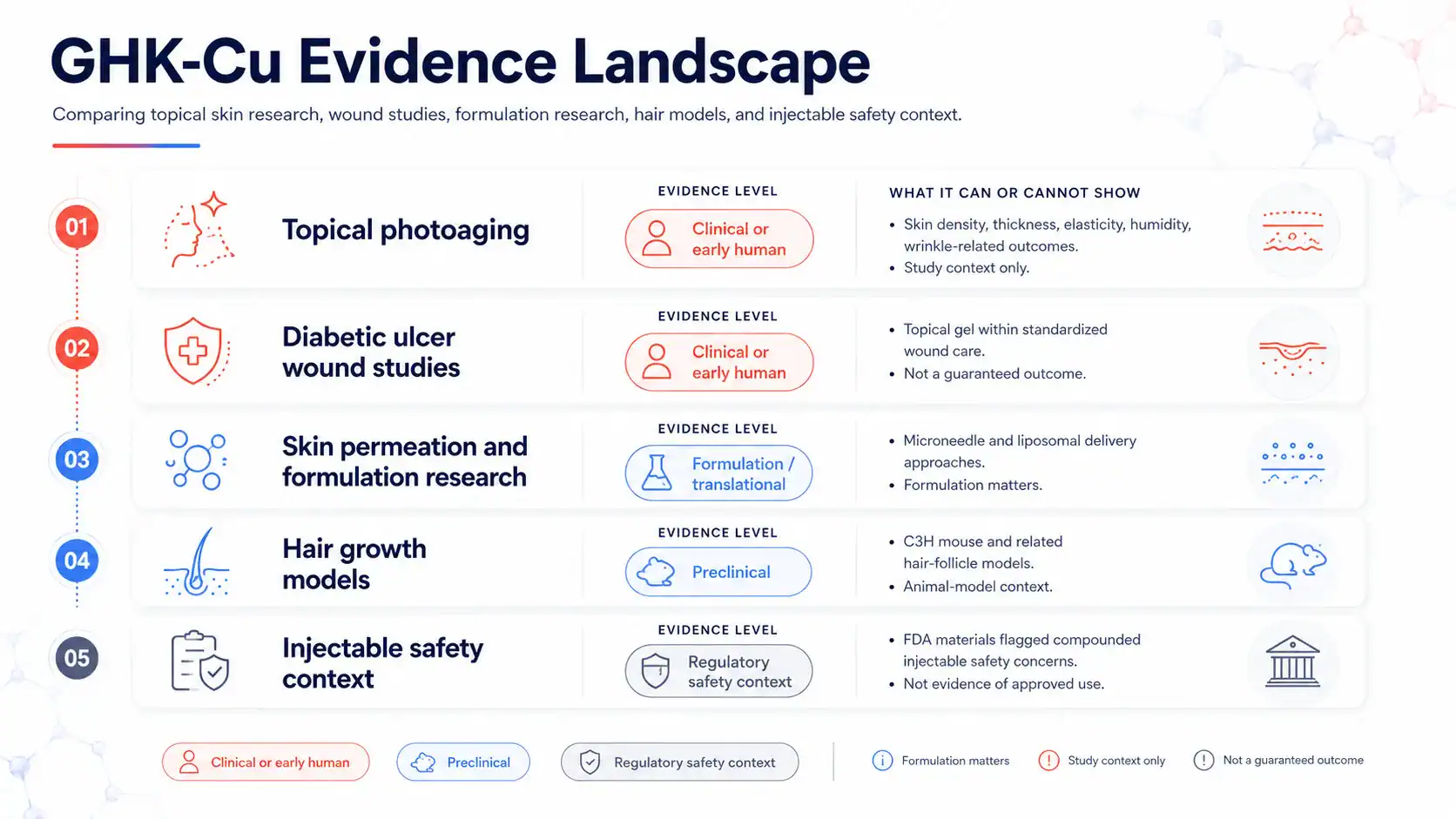
Most of the published human evidence is for topical cosmetic use in photoaged skin. If your interest is hair specifically, the Liu et al. 2024 Bioactive Materials paper on the ionic-liquid microemulsion delivery system is the most recent preclinical comparison against minoxidil. The March 2026 Lu et al. review in Systems Microbiology and Biomanufacturing is the most current synthesis of mechanisms and biomanufacturing context. These compounds operate through entirely different mechanisms and are not interchangeable. AHK-Cu was the active compound in the Pyo et al. 2007 dermal papilla study often cited as evidence for GHK-Cu’s hair-growth potential.
How Does GHK-Cu Work? Evidence, Benefits, and Mechanisms

GHK-Cu is well established as a cosmetic ingredient used topically — which is regulated differently from drugs. Many claims come from laboratory and small studies; cosmetic appearance benefits should be distinguished from unproven medical treatment claims. As a topical cosmetic ingredient it is well established; systemic or injectable GHK-Cu is investigational and not an FDA-approved drug.